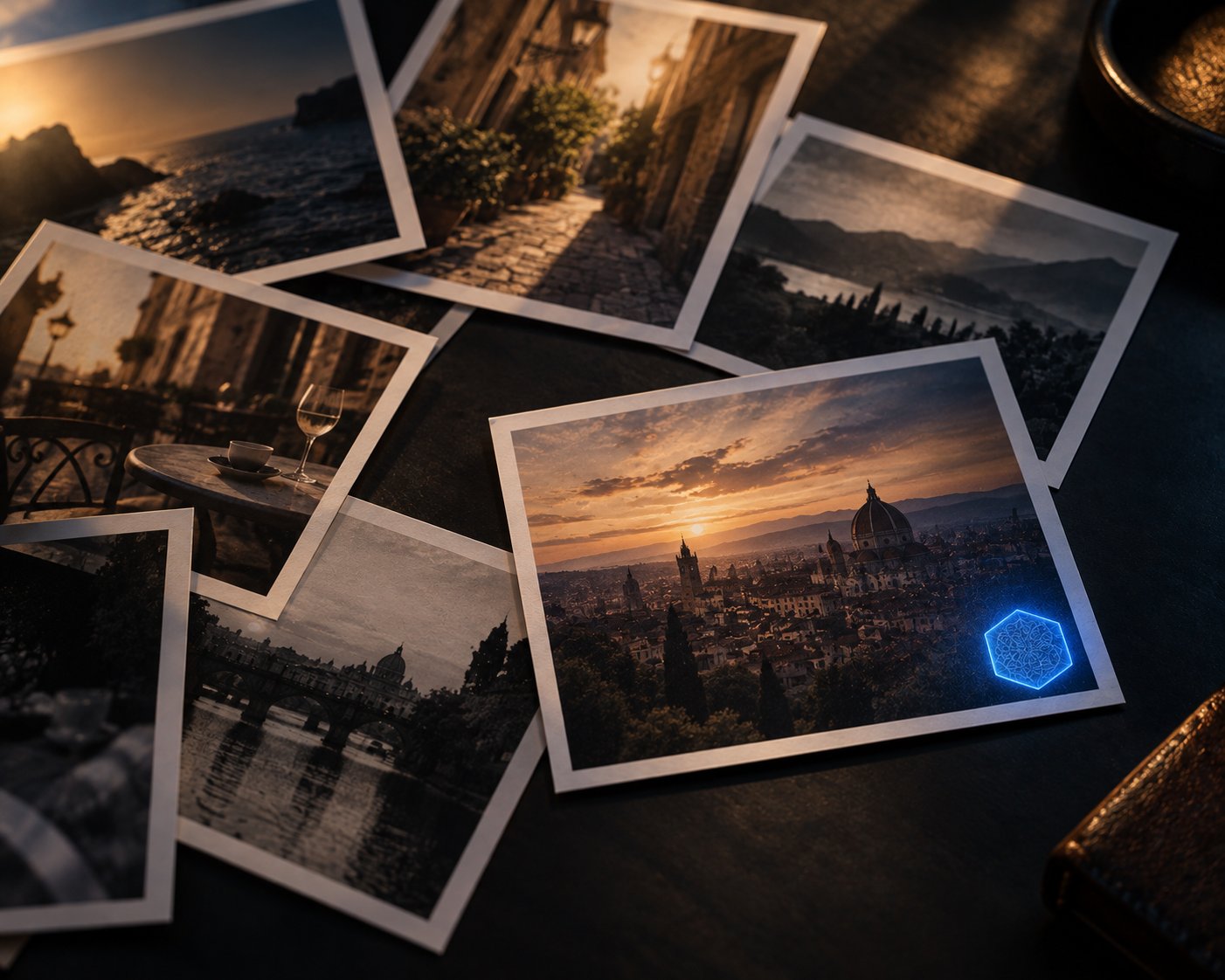
This image is AI-generated. The article below is about why knowing that matters.
Code found in an iOS 27 beta released in August 2026 points to a feature almost nobody is asking for today, but many of us may need soon. Testers digging through the beta found references to something called "Apple Reference Image," a system for proving that a photo actually came out of an iPhone camera and hasn't been altered since. Apple hasn't announced it. Reporting on the beta code says it isn't live yet, and it might not even ship with iOS 27's initial release.
Apple building that logic into a camera app, even as unannounced beta code, is a signal worth reading closely, and not just if you care about photography.
How Reference Image appears to work
The feature reportedly lives in an opt-in "Reference" mode inside the Camera app. Shoot a photo in that mode, and extended metadata gets baked in at capture. If you later want to prove the photo is authentic, you tap a Reference badge, and the raw image and its provenance data get sent to Apple's Private Cloud Compute servers, along with sensor signatures, the capture time window, and a hardware identifier for the specific camera sensor. The raw image is sent into Private Cloud Compute for verification, but the system is designed so Apple cannot inspect it. Apple receives the sensor data, a hash, and the verification result instead. Private Cloud Compute confirms the image came from a real iPhone sensor, assigns it a unique ID, and hands back an authenticated version that carries a verifiable badge across iPhone, iPad, and Mac.
Apple can also revoke earlier authentications if it later decides a sensor has been compromised. That turns authentication into an ongoing trust system rather than a permanent stamp issued once and forgotten. It's worth being precise about what that actually proves, though: revoking an authentication revokes trust in the sensor's attestation. It doesn't mean Apple is reassessing whether whatever the photo depicts is still true.
Apple already tags AI edits, quietly
This isn't Apple's first attempt at a version of this problem. Apple first added the Clean Up tool to the iOS 18.1 beta in August 2024; iOS 18.1 itself shipped publicly in October 2024. Using Clean Up in Photos to remove an object from a picture writes "Modified with Clean Up" into that photo's EXIF Credits field. You can find it by opening the photo and swiping up to see its details. It survives a share over iMessage or AirDrop. It disappears the moment you share that same photo to WhatsApp or most other apps, because those platforms strip metadata on upload.
That's the quiet, low-visibility version of the same idea Reference Image is reportedly trying to solve with more force: a hardware-backed signature and a server-side check, instead of a line of text almost nobody thinks to look for.
Why this is happening now
Generative AI has gotten good enough that a fake photo and a real one are often indistinguishable on sight. That's a problem for anyone whose job depends on a photo being trusted: journalists, insurance adjusters processing a claim, investigators building a case, or a small business owner who just wants a customer to believe the "before and after" shot is real.
If this ships, Apple would be well behind the rest of the camera industry here, not ahead of it. Leica's M11-P, released in 2023, was the first camera built with Content Credentials, and Leica has since added support across more of its lineup. Google's Pixel 10 attaches Content Credentials to every photo the Pixel Camera app takes, by default, no setup required. Nikon shipped a firmware update to the Z6III in August 2025 adding its own C2PA-based "Authenticity Service." Sony's PXW-Z300 camcorder supports C2PA authenticity too, though it requires a separate license to turn on. All of it runs on the same open standard: C2PA.
The reported Reference Image design doesn't appear to use C2PA. Based on what's been found in the beta code, it looks like a system of Apple's own, tied to Apple hardware, Apple software, and Private Cloud Compute, rather than the standard the rest of the industry has converged on. That's a narrower claim than "Apple rejected C2PA": nothing public says Apple has ruled out using it elsewhere. But it raises a real question. Provenance is only useful if it travels, across platforms, across editing tools, across whoever's checking it. Does that still work if every company builds its own separate trust chain instead of a shared one?
Authenticity is not truth
There's a limit worth keeping straight before going further. A camera can prove its sensor captured a set of photons, at a given time, through a given lens. It can't prove the scene wasn't staged, wasn't misleadingly framed, wasn't a screen playing a fake image, or wasn't a printed photo re-photographed for exactly this reason. C2PA calls this provenance: where media came from and how it changed. It does not claim to determine whether what the image says happened actually happened. Apple's system, if it ships, would be making the same narrow kind of claim: my sensor captured this. That's a different thing from "this is what really happened," and the difference matters most in exactly the fields where this gets used: journalism, insurance, courts, and AI governance.
The catch
There's also a real limitation with the mechanics themselves. Reference mode is opt-in and reportedly not available to third-party camera apps, so most photos taken on an iPhone, including nearly everything shared on social media, won't carry this proof at all. Photos shared on social platforms are also frequently recompressed and stripped of metadata before anyone sees them, which undercuts the whole system for exactly the kind of viral image it's meant to catch.
There's also a question nobody's answered yet: how much editing breaks the authentication. Nudging the exposure or the background color is a different act than replacing the whole background with something generated, and that's different again from a photo that's AI-generated from nothing. Right now there's no public detail on where Apple draws that line, or whether it's one line at all rather than several. A system that treats a color correction the same as a fabricated background isn't really measuring what it claims to measure, and until Apple says otherwise, that's an open question rather than a solved one.
So this is not a tool for stopping misinformation at scale, and it might not even ship. It's a narrower, higher-stakes case: someone who specifically needs to prove a photo is real, a claims adjuster, a courtroom, a newsroom fact-checking a submission.
What this means if you run a small business
I'd pay attention to this even if you never touch Reference mode yourself, and even if it never ships. The direction is the important part. Camera makers, and now reportedly Apple, are building hooks for "prove this is real" into their core products, which means customers are being trained, slowly, to expect that option to exist. A year from now, "how do I know this photo, this review, this testimonial is genuine" won't be a question only journalists and insurers ask.
If your business already uses AI for marketing images, product mockups, or written content, this is a good moment to get your own house in order before customers start asking, and the right test is materiality, not a blanket rule. Nobody needs a disclosure because you used AI to fix a crop or clean up a background. It matters when the gap between synthetic and real could change what a customer believes: a product photo that doesn't show the actual product, a testimonial nobody actually gave, a "before and after" that never happened. Keep a simple record of which of those you've used and where, the same way you'd keep receipts. If a customer or a platform ever asks you to prove a photo or claim is genuine, you want an answer ready, not an explanation you're improvising on the spot.
Where Agent Micho Fits
That's a control-discipline problem, and it's the same one we help small businesses build around their AI-generated content more broadly: know what's material enough to disclose, keep a record of it, and have an answer ready before someone asks.
Sources
- Discovery of "Apple Reference Image" strings in an iOS 27 beta and how the feature reportedly works: MacRumors, August 10, 2026.
- Additional detail on the Private Cloud Compute data flow, including that the raw image is sent for verification but the system is designed to keep Apple itself from accessing it: 9to5Mac, August 10, 2026.
- Additional context on who Reference mode is built for: AppleInsider, August 12, 2026.
- Caveats on rollout timing and iPhone 18 Pro exclusivity: Macworld.
- Google Pixel 10's default use of Content Credentials on every photo: Google.
- Nikon Z6III firmware 2.00 and the C2PA-based Authenticity Service, August 27, 2025: Nikon.
- Leica M11-P as the first camera built with Content Credentials: Content Authenticity Initiative.
- Sony PXW-Z300 C2PA authenticity support and its separate license requirement: Sony Professional.
- iOS 18.1's public release date, October 28, 2024: Apple Newsroom.
- Apple's existing "Modified with Clean Up" EXIF Credits label: iDownloadBlog, August 29, 2024.
Also from Konkan Sun: if proving a photo is real matters to your business, Konkan Sun Productions is the real, camera-shot photography and video team behind Society of Scents and Spirits, not stock or AI-generated substitutes. Worth a look if that's what you need.