Most service businesses lose repeat clients not because of the quality of the work. The work was fine. They lose them because nobody followed up. The job was completed, the client was satisfied, and then silence. No thank-you, no check-in, no re-engagement. The client moved on, not because they were unhappy, but because there was no particular reason to come back.
A 2023 study on service business retention found that clients who received a follow-up within 24 hours of job completion were 60 percent more likely to book again. Most service businesses follow up when someone remembers to, which means inconsistently, and often too late for the timing to matter. Automated sequences close that gap every time, without exception.
The Three-Beat Sequence That Works
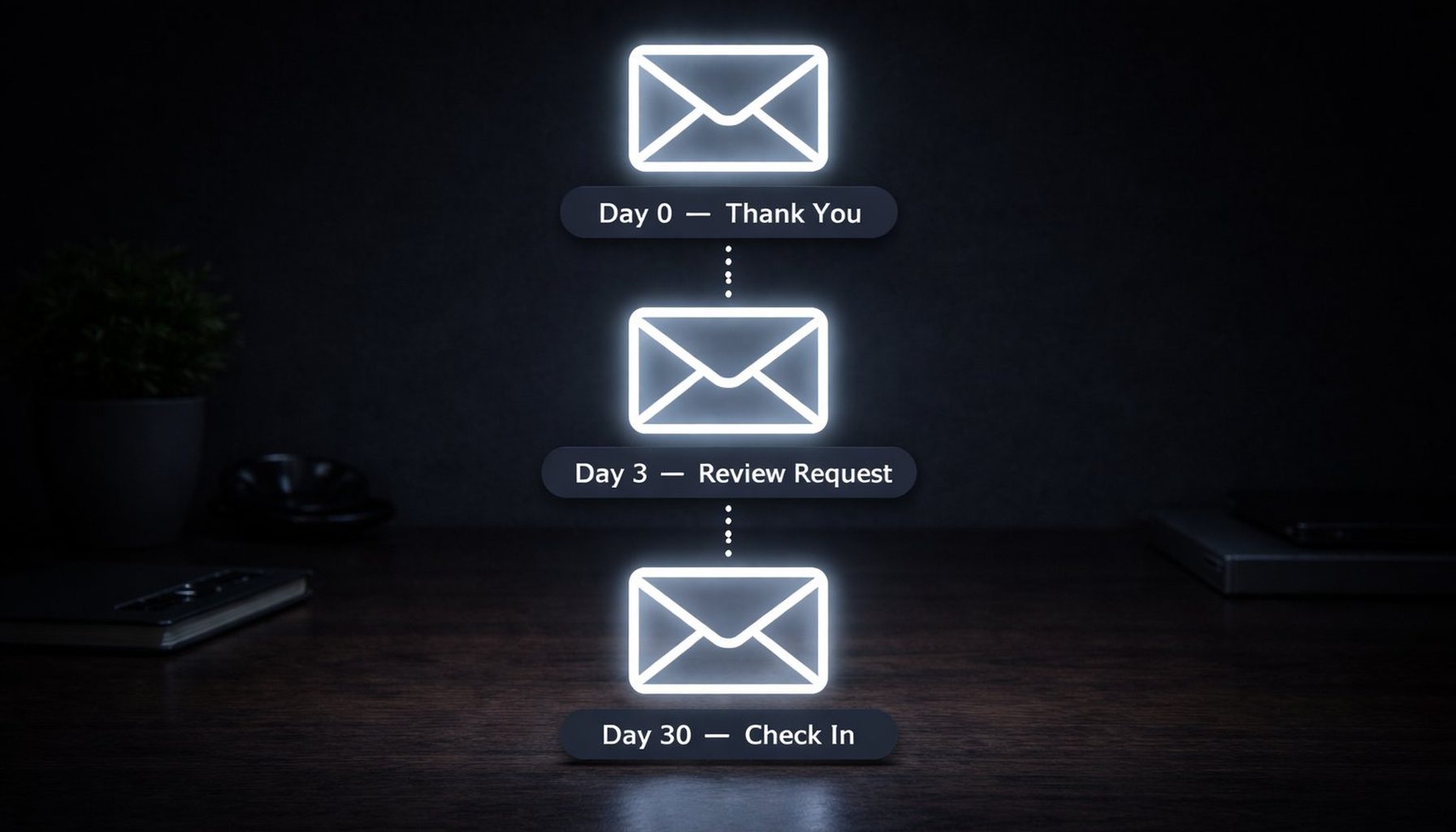
The follow-up sequence that retains clients has three distinct beats, each serving a different purpose at a different point in the client's experience.
Beat one: the same-day thank-you. This goes out the day the job is marked complete. Not a form letter. A message written in your voice that acknowledges the specific project, expresses genuine appreciation, and lets the client know you are there if anything comes up. The timing is important. A message that arrives the same day reinforces the feeling that the experience mattered. A message that arrives a week later, if it arrives at all, does not.
Beat two: the day-three review request. Not "please leave us a review on Google." A specific, low-friction ask: one link, one sentence, and language that invites honest feedback rather than demanding a five-star rating. The timing matters because three days is long enough for the client to have used the work and formed an opinion, but short enough that the experience is still fresh and the positive feeling has not faded.
Beat three: the thirty-day re-engagement. A short note asking if there is anything else on their list. No promotion, no discount, no urgency. Just a reminder that you are available and a natural opening for the client to come back into the conversation. Clients who receive this message book follow-on work at roughly twice the rate of those who do not.
Where the Personalisation Actually Lives
The misconception is that automated means generic. It does not have to be, and for a well-designed follow-up system, it should not be.
Most CRM and automation platforms can pull the client name, the project name, the completion date, the assigned team member, and any custom fields you have set up, and insert them into the message dynamically. The recipient reads a message that references their specific project, sent at a timing that makes sense, in the voice of the business they worked with. That is not a generic message. That is a personalised message that happens to have been generated automatically.
The difference between a follow-up sequence that feels warm and one that feels impersonal is entirely in the template writing. An automated message with a first-name merge field and corporate language feels automated. An automated message written in plain language, referencing the actual work, and asking a real question feels like a person who pays attention.
Spend the time on the templates. Write them the way you would write them if you were sending each one personally. Use the language your clients use. Reference specifics. Keep it short. The automation just makes sure that message reaches every client, every time, at exactly the right moment.
The Tech Stack That Makes It Work
A basic follow-up automation requires three components: a trigger source, an automation platform, and a messaging tool.
The trigger source is wherever you record that a job is complete. This might be a job management system, a CRM, a booking platform, or even a simple spreadsheet with a status column. The automation monitors this source for the completion trigger and fires the sequence when it sees it.
The automation platform handles the logic: when the trigger fires, send message one. Wait three days, send message two. Wait thirty days with no response, send message three. If the client responds at any point, pause the sequence and flag the conversation for human attention. Platforms like Zapier or N8N handle this kind of conditional logic cleanly.
The messaging tool delivers the messages through whatever channel your clients expect: email, SMS, or WhatsApp, depending on your client base and what they have opted into. For most service businesses, email is the right default. It gives clients time to respond on their own schedule and keeps a record of the conversation.
The entire stack can be set up in a day for a basic implementation. A more sophisticated version with CRM integration, dynamic content insertion, and multi-channel delivery takes longer, typically a week of design, build, and testing. The payback period on that investment, for a business doing meaningful client volume, is measured in weeks.
What Breaks Without It
The cost of not automating follow-up is not one missed booking. It is a pattern that plays out across every client, every week, indefinitely. Busy weeks mean no follow-ups. Busy periods tend to cluster, which means the clients who had work done during your most productive periods, and are therefore most likely to need more work, are the ones least likely to hear from you. The clients who needed you least are the ones who got the follow-up.
No follow-ups means lower retention. Lower retention means more time spent acquiring new clients, which costs five to seven times more than retaining existing ones. That ratio compounds against you quietly over months and years. The business owner who automates follow-up is not just saving administrative time. They are changing the economics of client acquisition.
The automation does not replace the relationship. It prevents the relationship from ending due to neglect. Every client who comes back because they received a timely, thoughtful follow-up is a client who did not need to be found again from scratch. If you want to set up a follow-up sequence for your business, I can have something running within a week.
What to Measure and When
A follow-up sequence that is live but unmeasured is a system you cannot improve. Define what success looks like before the sequence goes live, and build the measurement into the system from day one.
The metrics worth tracking for a client follow-up sequence are straightforward. Open rate and response rate for each message in the sequence: what percentage of clients open the thank-you, respond to the review request, or reply to the re-engagement message? Review generation rate: how many reviews per 100 completed jobs is the sequence producing compared to the baseline before automation? Repeat booking rate: what percentage of clients who go through the full sequence book again within 90 days?
Compare each metric to a baseline from before the sequence was active. If you do not have historical data, use the first 30 days after launch as the baseline and measure improvement from there. The absolute numbers matter less than the direction and the rate of change.
Use the data to improve the templates. If the day-three review request is getting a 12 percent response rate and the industry benchmark is 20 percent, the timing or the language needs adjustment. Test one change at a time so you know what produced the improvement. A revised subject line, a different ask, a shorter message, a different sending time: test each one separately and measure the result before moving to the next.
The sequence is not a set-and-forget system. It is a living element of your client retention operation. The automation makes it consistent. The measurement makes it better. Both are required for it to produce the results it is capable of producing. A sequence that was designed thoughtfully and then measured and refined over 12 months will dramatically outperform one that was deployed once and never revisited.
The follow-up sequence is not the relationship. The relationship is built in the conversations, the project work, and the moments where you demonstrate that you understand what the client actually needs. The follow-up sequence is what keeps the door open for those moments to happen again. It is the operational infrastructure that prevents neglect from ending relationships that should have continued. Build it once, measure it consistently, and let it do the work of keeping clients in your orbit while you focus on the work that actually requires your presence.
Client retention is the most underleveraged area in most service businesses because the cost of client loss is invisible in a way that client acquisition is not. You can see what you spent on marketing. You cannot easily see what you lost because someone did not hear from you at the right moment. Automated follow-up makes retention active rather than passive. It ensures that the goodwill from a completed job translates into the next booking rather than dissipating into silence. That is not a complicated outcome to produce. It just requires a system that makes it happen consistently.
Build the sequence. Set it running. Measure the retention rate before and after. The improvement will be visible within 90 days, because 90 days is enough time for the sequence to have run its full course for a meaningful number of clients. Once you have seen the numbers, the decision about whether to continue maintaining and refining it will be straightforward. It almost always is.